
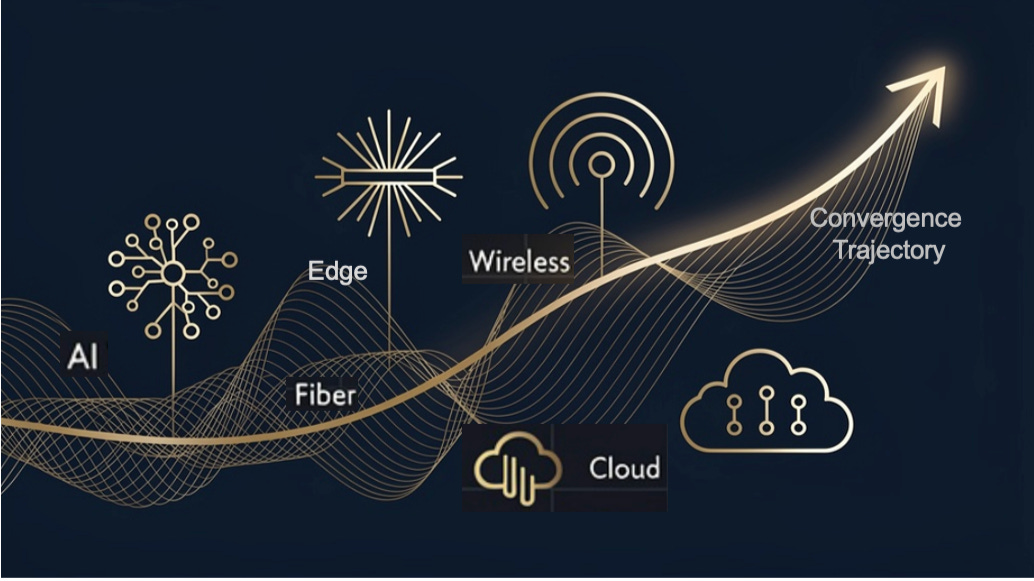
Investors are still using linear frameworks to value a non-linear transformation. ARPU models. Churn forecasts. CAPEX normalization curves. All built on the assumption that technology waves evolve independently. They don’t anymore.
The challenge isn’t any single technology wave. It’s synchronization—where each generational shift triggers cascading changes across other layers, forcing the entire infrastructure to evolve in ways that aren’t predictable from any single trajectory.
For the first time in telecom history, multiple technology waves that historically evolved independently are now colliding. Massive FWA buildouts—fueled by newly available midband spectrum—are driving exponential demand for fiber backhaul. Edge compute proliferation is creating unprecedented metro fiber density requirements. AI workloads are reshaping data center interconnect economics. And all of this is happening while both private capital and government subsidy programs (BEAD, state broadband funds) are simultaneously flooding the market with fiber deployment dollars.
When cycles synchronize, the game changes:
1. Infrastructure Becomes Interdependent
There’s no such thing as a “single upgrade” anymore. Transport delays constrain AI deployment. Inadequate midband refarming throttles FWA growth. Missing metro fiber undermines edge computing economics. Every layer pulls on every other layer.
2. CAPEX Intensity Spikes
Not due to poor discipline, but because piecemeal evolution is no longer viable. Operators can’t cherry-pick which layers to upgrade—the architecture demands simultaneous investment across the stack.
3. Forecasting Windows Collapse
Historical valuation multiples rely on pattern recognition: stable ARPU cycles, predictable churn, linear cost curves. These patterns shatter when five architectural layers migrate at once.
This is why market volatility has intensified. Wall Street isn’t overreacting to isolated events—it’s underpricing a fundamental convergence that traditional models weren’t built to capture.
The KPIs that guided investors from 2005 to 2020—ARPU growth, churn rates, EBITDA margin stability—are now lagging indicators in a synchronized cycle.
The real signals lie in cross-architecture dependencies:
How does fiber density amplify midband productivity?
How does FWA adoption reshape suburban fiber ROI?
How does AI compute demand restructure transport economics?
Investors who map these interdependencies—not just track isolated metrics—will spot structural inflection points before the market reprices them.
The question isn’t whether your portfolio can weather the next upgrade cycle. It’s whether your analytical framework recognizes that all the cycles are now one.
About Bill Stueber and Telecom Partners Group
Bill Stueber is a forty-year telecom veteran and founder of Telecom Partners Group.
His perspective blends hands-on operating leadership with the valuation discipline and rigor of Wall Street.
He has led wireless companies as CEO, advised global investment banks on technology, spectrum and infrastructure strategy, building models that turn complex technology migrations—5G, FWA, fiber, satellite, and AI-driven networks—into clear, actionable financial insight.
#TelecomInvesting #NetworkEconomics #Infrastructure #TMT #InvestmentStrategy #5G #FiberOptics #AIInfrastructure #StrategicAnalysis